
As voters weigh Question 2, the debate intensifies over the impact of standardized testing on student success and educational standards
By Heidi Christen
November 4, 1004
Massachusetts voters, there’s an important decision about whether high school diplomas should remain tied to the MCAS (Massachusetts Comprehensive Assessment System). Currently, students must pass the MCAS in English, Math, and Science to graduate. The proposed change under Question 2 would eliminate this requirement, allowing districts to certify coursework as meeting state standards instead.
What a “Yes” Vote Means
A “Yes” vote would eliminate the MCAS as a mandatory graduation requirement. While students would still need to complete coursework aligned with state standards in English, Math, and Science, their diploma would no longer depend on passing the MCAS test. Proponents argue that this change promotes a more individualized assessment approach, focusing on GPA, coursework, and teacher evaluations.
What a “No” Vote Means
A “No” vote would maintain the current MCAS graduation requirement. This means students must still pass the MCAS to receive a diploma, ensuring a standard assessment across the state. Opponents argue that removing the MCAS requirement could lead to inconsistencies in graduation standards across districts and that a statewide test is a fair baseline measure for readiness.
Fiscal Impact and Funding
State analyses indicate that the proposed change to the MCAS graduation requirement is not expected to have any fiscal impacts, suggesting that moving away from standardized testing as a graduation requirement will not impose additional financial burdens on the state education system.
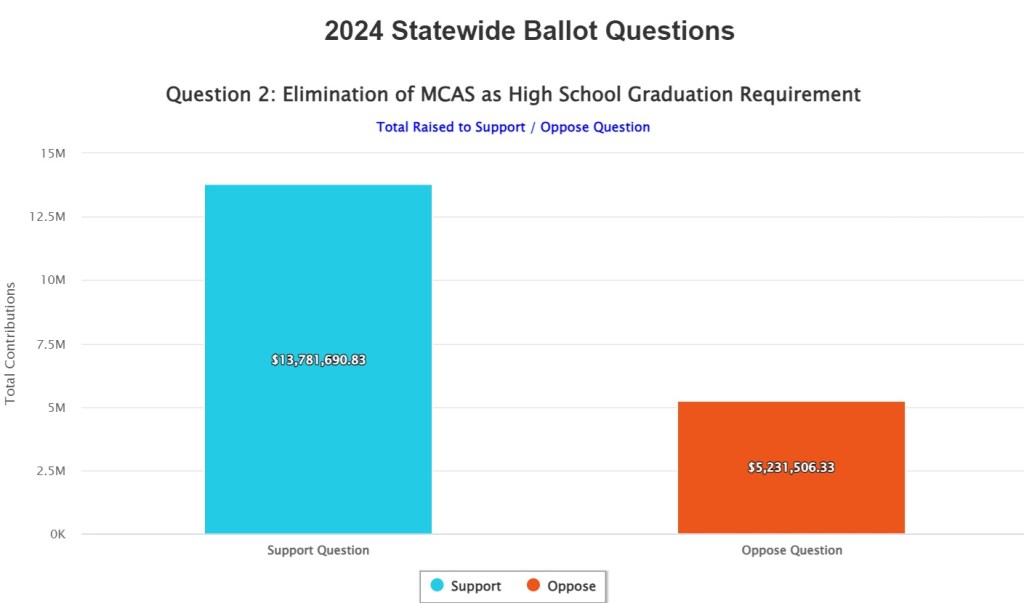
In terms of financial backing, the campaign to support Question 2 has raised substantial contributions, totaling $13.78 million, compared to $5.23 million from those opposing it. This significant disparity underscores the robust backing from prominent Boston figures and organizations advocating for change.
The Buzz Around the Debate
The proposed change has sparked a high-profile debate in Massachusetts, drawing in political figures, educators, and even celebrities like Matt Damon. Supporters argue that eliminating the standardized test requirement empowers teachers to better assess student readiness, while opponents warn it could create inconsistent graduation standards statewide.
The Massachusetts Teachers Association strongly endorses a “Yes” vote, stating that standardized tests disproportionately disadvantage students of color and those with learning disabilities. In an interview, Dr. Susan Egan, Director of Mental Health on the South Shore, highlighted that standardized tests can create significant stress for students, particularly those with learning disabilities or mental health challenges. She advocates for a more comprehensive assessment model that promotes a supportive academic environment. You can view the full interview here.
In contrast, Secretary of Education Patrick Tutwiler, in an interview with the Boston Globe, reaffirmed his and Governor Maura Healey’s commitment to maintaining a “state standard” for graduation. “That question, if it passes, would deliver us to a place of no standard, essentially 351 different standards for high school graduation,” he stated in March.
Joining the discussion, Matt Damon has appeared in a video for the Yes On Question 2 campaign, urging the public to trust teachers in evaluating student readiness through diverse assessment methods.
Conclusion
Ultimately, voters will weigh whether the MCAS is the best measure of graduation readiness or if a more diverse set of criteria would be more beneficial for Massachusetts students. The outcome will significantly impact educational policy and standards in the state.

 Raising Nana
Leave a comment